
Metal roofing in Hawaii is popular for good reasons: it sheds heavy rain, stands up to trade winds, reflects a lot of sun, and can last far longer than asphalt. But the islands are also one of the hardest places in the country for metal, because salt air eats the wrong metal fast. This guide covers the choices that matter most here: steel or aluminum, standing seam or exposed fastener, which finish, what it costs, and how far from the ocean each option is actually warranted.
Warranty terms below are quoted from manufacturer warranty documents, and prices from a published 2026 Hawaii cost guide, both checked November 18, 2026. Always read the exact warranty for the product on your quote.
On the Big Island the choice matters on both coasts: Kona homes take strong sun and salt air, while Hilo gets heavy rain most of the year.
Is metal roofing in Hawaii a good choice?
For most homes, yes, if it is specified for your location. The main advantages and trade-offs:
| Advantages in Hawaii | Trade-offs to plan for |
|---|---|
| Long service life when the metal and finish suit the site | Higher up-front cost than asphalt shingles |
| Strong wind performance, especially concealed-fastener standing seam | Steel can corrode quickly near salt water; warranties often exclude coastal lots |
| Sheds heavy rain quickly (important on the Hilo side and Upcountry) | Exposed fasteners and washers need periodic checks |
| Reflective finishes help keep attics cooler | Rain noise if installed without solid deck and underlayment |
| Works well under solar when planned up front | Some finish warranties are void where solar or other items are attached |
Steel vs aluminum: the salt-air decision
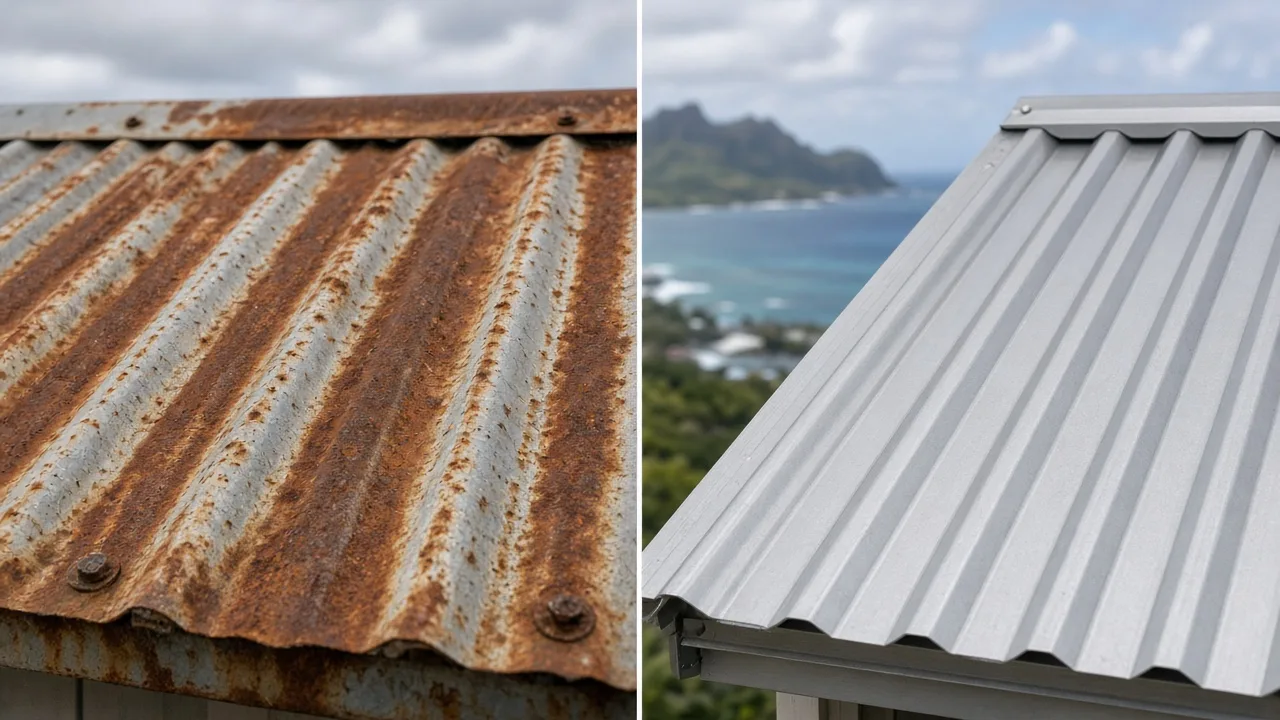
This is the most important choice you will make. Steel roofing (usually Galvalume, a steel sheet with an aluminum-zinc coating) is strong and less expensive. Aluminum has no steel core to rust, so it is the usual pick for homes close to the water. Manufacturer warranties draw the line in writing, and the distances differ by product:
| Warranty document | Steel near the ocean | Aluminum near the ocean |
|---|---|---|
| PAC-CLAD (Petersen) PVDF paint warranty, Hawaii edition | PVDF-painted steel within 1,500 feet of a seacoast is excluded | Covered within 1,500 feet for a reduced 25-year term, if the owner rinses the roof with fresh water at least twice a year |
| Taylor Metal Products, unpainted Galvalume Plus 25-year warranty | Does not apply within 1,000 feet of salt water, salt spray, or a marine environment | Aluminum is recommended for these locations |
The Taylor Metal warranty also says projects near active volcanic vents need a manufacturer review before installation, which matters for some homes on Hawaii Island where vog is a factor. If your home is within roughly a quarter mile of the shoreline, or downwind of vog, raise it at the estimate.
Our coastal-distance decision guide
Use this as a starting point for your conversation with a roofer. It is built from the warranty terms above, not from a single rule, because no single distance applies to every product.
| Your location | Usually a good fit | Ask your roofer about |
|---|---|---|
| Oceanfront or within about 1,000 feet of the shore (Kihei, Lahaina, Kailua-Kona coast) | Aluminum with a PVDF (Kynar-type) finish; stainless or coated fasteners | Rinse requirements to keep the warranty; trim and flashing metals; whether any steel parts are used |
| About 1,000 to 1,500 feet from salt water | Aluminum, or steel only if the specific warranty covers your distance | The exact distance in the warranty and how it is measured (surf, bay, marsh) |
| Well inland and upslope (Upcountry Maui, Waimea, Volcano) | PVDF-painted Galvalume steel is commonly used and costs less | Rainfall and moisture, underlayment, and fastener type |
| Near active volcanic emissions | Get the manufacturer’s approval in writing | Product choice and warranty review before ordering |
Standing seam vs exposed-fastener panels
After the metal itself, the panel style is the next big choice.
- Standing seam panels join at raised seams and fasten to the deck with hidden clips. There are no screws through the face of the roof, which means fewer leak points and better movement as the metal expands in the sun. It costs more and is the common choice for homes.
- Exposed-fastener panels (rib, corrugated, and 5V-style panels) are screwed through the face with sealing washers. They are cheaper and fast to install, and common on outbuildings and some homes. The washers age in UV and heat, so plan on periodic inspection and fastener replacement over the roof’s life.
- Metal shingles and shakes give a traditional look with metal’s durability, at a price between the two.
How much does metal roofing cost in Hawaii?
The Roof Observations 2026 Hawaii roof cost guide lists these average installed prices, including standard components and tear-off of the old roof. We added the total for a 2,000 square foot roof.
| Metal roof type | Avg. installed per sq ft | 2,000 sq ft roof |
|---|---|---|
| Exposed-fastener panels, steel, basic coating | $9.90 | $19,800 |
| Exposed-fastener panels, steel, PVDF/Kynar | $12.35 | $24,700 |
| Exposed-fastener panels, aluminum, basic coating | $13.20 | $26,400 |
| Metal shingles, steel, PVDF/Kynar | $15.70 | $31,400 |
| Standing seam, steel, basic coating | $15.35 | $30,700 |
| Standing seam, steel, PVDF/Kynar | $19.10 | $38,200 |
| Standing seam, aluminum, basic coating | $20.40 | $40,800 |
| Standing seam, copper | $40.80 | $81,600 |
For comparison, the same guide lists architectural asphalt shingles at $7.40 per square foot. Metal costs roughly two to three times as much up front, which is why the decision usually comes down to how long you will own the home and how close you are to the water.
Finishes, colors, and heat
Most quality metal roofing in Hawaii uses a PVDF finish (often sold as Kynar 500 or Hylar 5000), which holds color and resists chalking better than basic polyester paints. Lighter colors reflect more sunlight, which helps keep attics cooler in places like Kihei and Kona. Pair a reflective roof with good attic ventilation for the best result; our guide to energy-saving roofing for Maui’s hot climate covers ventilation and other ways to cut heat.
Installation details that make or break a metal roof here
- Fasteners and clips must match the panel metal and the exposure. Lava Roofing specifies corrosion-resistant fasteners on coastal jobs by default.
- No dissimilar metals. The PAC-CLAD warranty excludes damage from contact with, or runoff from, copper or lead, and from wet lumber or damp underlayment. Ask what flashing and trim metals will be used.
- Underlayment rated for high temperatures under metal, with extra protection in valleys and around penetrations.
- Solar planning. Some finish warranties are void where solar panels are attached to the metal. Choose the panel, the solar mounting, and the warranty together before the roof goes on.
- A licensed roofer. Roofing in Hawaii falls under the C-42 roofing contractor classification. Lava Roofing is licensed and insured, CT-39063.
Caring for a metal roof in salt air
Metal is low-maintenance, not no-maintenance. Rinse salt residue with fresh water if your warranty requires it (the PAC-CLAD coastal terms call for at least twice a year), keep leaves and debris out of valleys and gutters, and have exposed fasteners and flashings checked every few years. Catching a scratched panel or a failed washer early is far cheaper than chasing rust later.
Think of an oceanfront home in Lahaina weighing a painted steel roof against aluminum. The steel quote is lower, but if the warranty excludes the lot because of its distance to the water, that savings comes with no coverage. Comparing the warranty documents side by side usually settles it. (Illustrative example, not a specific customer.)
Still deciding between metal and other materials? See how to choose the best roofing material for your Maui home, or for a specialty look, read about Bermuda-style metal roofs in Hilo.
Talk to a local metal roofer
Lava Roofing installs metal, asphalt shingle, and tile roofs across Maui and Hawaii Island, with local crews in Kona, Hilo, Maui, and Lahaina and more than 25 years on the islands. Every job starts with a free site visit and a written estimate. Call Maui (808) 793-6635, Lahaina (808) 793-5520, Kona (808) 746-2314, or Hilo (808) 825-6463, or request an estimate online.
Frequently asked questions
What is the average cost of a metal roof in Hawaii?
A 2026 Hawaii cost guide lists metal roofing from about $9.90 per square foot for basic exposed-fastener steel to $20.40 for aluminum standing seam, installed with tear-off. On a 2,000 square foot roof that is roughly $19,800 to $40,800 before GET, permits, or deck repairs.
What is the average cost of a 2,000 square foot metal roof?
Using the same 2026 Hawaii figures, about $24,700 for PVDF-painted exposed-fastener steel, $38,200 for PVDF-painted steel standing seam, and $40,800 for aluminum standing seam. Your measured roof area and site conditions change the total.
What is the biggest problem with metal roofs in Hawaii?
Corrosion from salt air when the wrong metal is used near the coast. Manufacturer warranties often exclude steel within 1,000 to 1,500 feet of salt water, so coastal homes usually need aluminum. Other issues are aging exposed fasteners and rain noise if installed without a solid deck.
What is the best roofing material for Hawaii?
It depends on location and budget. Aluminum standing seam is a strong choice near the ocean, painted steel works well inland, and architectural shingles are the budget option. Wind rating, salt exposure, rainfall, and how long you plan to stay should drive the choice.
Is aluminum or steel better for a roof near the ocean?
Aluminum. It has no steel core to rust, and manufacturer warranties commonly exclude steel close to salt water while still covering aluminum, sometimes with a fresh-water rinse requirement.
Are metal roofs loud in the rain?
Over a solid plywood deck with underlayment, as on most homes, rain noise is usually modest. Panels fastened over open framing, as on some sheds and carports, are louder.