
A roof in Hawaii has to handle salt air, steady trade winds, strong sun and heavy rain, so who installs it matters as much as what goes on it. This guide shows how to choose a roofer in Hawaii: three questions to ask every contractor, a five-point pre-hire checklist, and a worksheet for comparing bids side by side.
Hawaii’s consumer office recommends getting estimates from three or more roofing contractors, comparing what you receive for the price, and remembering that the cheapest estimate may not necessarily be the best (DCCA/RICO Roofing Tips for Owners).
Download the free printable checklist (PDF, 2 pages)
The short version
- Verify the license yourself in the DCCA Public License Search. Roofing is the C-42 classification.
- Get a certificate of insurance from the roofer’s insurance agent: liability and workers’ comp.
- Insist on an itemized written bid, including how damaged decking will be priced.
- Get both warranties in writing: manufacturer (materials) and contractor (workmanship).
- Call two recent local references, and never pay the full amount up front.
The 3 questions to ask every roofer
Ask these on every call. Clear, specific answers are a good sign. Hedging is a reason to move on.
1. “What’s your Hawaii contractor license number, and can your insurance agent send me a certificate of insurance?”
A legitimate roofer can answer in seconds. Check the number yourself in the DCCA Public License Search or call the state at 844-808-3222. Roofing is the C-42 Roofing contractor classification in Hawaii’s contractor license list. The DCCA says a licensed contractor carries workers’ compensation and liability insurance, can obtain and sign building permits, and that the Contractors Recovery Fund may be available to you only if you hired a licensed contractor. If the answer is vague, keep looking.
2. “Is this an itemized bid, and what happens if you find rotted decking during tear-off?”
A real bid breaks out tear-off, decking, underlayment, materials, flashing, permits and cleanup line by line. Damaged decking often isn’t visible until the old roof comes off, so ask how replacement decking will be priced (for example, per sheet) before you sign, so a change order doesn’t surprise you mid-job.
3. “What does your workmanship warranty cover, and what does the manufacturer’s warranty cover?”
Hawaii’s consumer office explains that roofing usually carries two guarantees: the manufacturer’s and the contractor’s. Manufacturer guarantees mostly cover the product itself; contractor guarantees usually cover workmanship and water tightness. Any contractor guarantee valid for more than seven years must be accompanied by a bond (DCCA/RICO Roofing Tips for Owners). Ask whether each warranty transfers to a buyer, what maintenance it requires, and whether adding solar or other roof penetrations voids it.

The 5-point pre-hire checklist
Before you sign anything, confirm all five. Any missing item is a reason to pause.
| Check | How to verify | Red flag |
|---|---|---|
| 1. Active Hawaii contractor license for roofing work | Look up the business and license number in the DCCA Public License Search; a roof-only job calls for the C-42 Roofing classification (or a general contractor for multi-trade work). | License number missing, “pending”, or registered to a different business name |
| 2. Liability insurance and workers’ comp | Ask for a certificate of insurance sent directly by their insurance agent, naming your project address. | “We’re covered, don’t worry about it” |
| 3. Itemized written bid | Tear-off, decking allowance and how it’s priced, underlayment, roofing material, flashing, ventilation, permits, disposal and cleanup, schedule and payment terms. | One total on a business card, or a large cash deposit |
| 4. Both warranties in writing | Manufacturer warranty (materials) and contractor workmanship warranty, with what voids each one and whether it transfers. | Verbal promises; a guarantee longer than seven years with no bond |
| 5. Two recent local references | Past 12 months, on your island, with similar roofing material. Call them. | No local jobs they can point to |
Licensed contractors in Hawaii must carry liability insurance and are responsible if a worker is injured on the job, which protects your property if something goes wrong (DCCA/RICO). A contractor license is required for any project that needs a building, electrical or plumbing permit, and for projects above a small dollar threshold set by state law (DCCA).
Bid comparison worksheet
Print this table (it’s also in the PDF) and fill in one column per roofer. Gaps in a column are the questions to ask before you choose.
| Line item | Roofer A | Roofer B | Roofer C |
|---|---|---|---|
| License number (verified, C-42 or general) | |||
| Certificate of insurance received from agent | |||
| Tear-off and disposal | |||
| Decking allowance and unit price | |||
| Underlayment type | |||
| Roofing material and color | |||
| Flashing, vents, ridge caps | |||
| Permit included | |||
| Workmanship warranty (years, bonded if over 7) | |||
| Manufacturer warranty | |||
| Start date and schedule | |||
| Payment schedule | |||
| Local references called |
What an itemized roofing bid should include
- Tear-off of the existing roof and disposal
- Decking inspection, with a written allowance for replacement and how extra sheets are priced
- Underlayment type and coverage
- Roofing material, brand, profile and color
- Flashing, drip edge, ventilation, ridge and hip caps
- Permit, if the job needs one, and who pulls it
- Cleanup, nail sweep and protection for landscaping
- Schedule, payment schedule and what happens if weather delays the job
- Both warranties, attached in writing
The two roof warranties, explained
According to Hawaii’s Regulated Industries Complaints Office, manufacturer guarantees mostly cover merchantability: the product is what the manufacturer says it is. Contractor guarantees usually cover workmanship and water tightness, not appearance. Any contractor guarantee longer than seven years must be accompanied by a bond. RICO also reminds homeowners that a guarantee is only as good as the company that issues it (DCCA/RICO).
- Is each warranty transferable to the next owner?
- Does it require maintenance on your part?
- Is it cancelled if the roof is penetrated, for example by adding solar?
- Who do you call, and how fast, if a leak appears?
Red flags
RICO receives hundreds of tips and complaints about unlicensed contractors every year. Its roofing tips flag these warning signs (DCCA/RICO):
- Door-to-door offers from someone who “just finished a job down the street” or has “materials left over”
- A license number that doesn’t match the business, or belongs to someone else (ask for photo ID)
- A request that you pull an owner-builder permit yourself, which may mean the contractor can’t get the permit
- Pressure to pay all of the money up front
Storm seasons bring more door knockers. After a hurricane, use the Maui roof hurricane prep checklist to document damage first, then take time to compare licensed roofers.
Permits on Maui
The County of Maui says a building permit is required for the construction, alteration, moving, demolition, repair and use of any building or structure in the county, and its Department of Public Works handles building permits (County of Maui). Some smaller jobs may be exempt under the county building code, so ask each roofer whether your job needs a permit and who will pull it. A licensed contractor is able to obtain and sign building permits (DCCA).
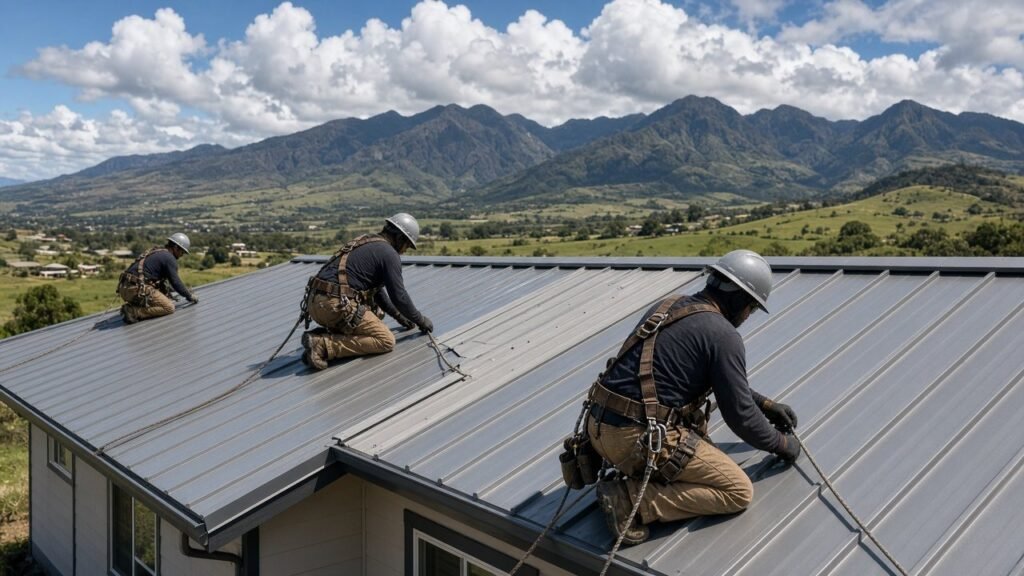
If your roof leaks after the job
RICO suggests calling the original roofer first and checking your guarantee, since you may still be covered. It also advises staying off your roof unless it is absolutely necessary, because your weight can crack older materials or void the warranty (DCCA/RICO). For storm-related leaks, see the top signs your roof needs repair after a storm and the wind damage roof insurance claim guide.
Download the printable checklist
The free two-page PDF includes the three questions, the five-point checklist and the bid worksheet, plus the Maui roof hurricane prep timeline.
Download the free printable checklist (PDF, 2 pages)
More Maui roofing guides
- Maui roof hurricane prep checklist
- How to choose a roofing contractor in Kihei, Maui
- Maui roof repair: top signs you need a fix after a storm
- Wind damage roof insurance claim: step-by-step guide
- Lava Roofing Maui
Comparing roofers on Maui?
Lava Roofing’s Maui team gives free on-site estimates. Call (808) 793-6635 or use the contact page, and use the checklist above with every roofer you talk to.
Lava Roofing is a licensed Hawaii contractor (CT-39063). Verify any contractor’s license on the state’s public license search.
Frequently asked questions
What questions should I ask a roofer before hiring?
Ask for the Hawaii contractor license number and a certificate of insurance from their agent; whether the bid is itemized and how damaged decking will be priced; and what the workmanship and manufacturer warranties each cover, and what voids them.
How do I check a roofer’s license in Hawaii?
Search the business name or license number in the DCCA Public License Search at mypvl.dcca.hawaii.gov, or call the state at 844-808-3222. Confirm the license is current and that the name matches the company on your bid.
What license does a roofer need in Hawaii?
Roofing falls under the C-42 Roofing contractor classification. For jobs that combine several trades, Hawaii’s consumer office suggests considering a licensed general contractor, who hires licensed specialty subcontractors.
Should I choose the lowest roofing bid?
Not automatically. Hawaii’s consumer office advises getting estimates from three or more roofing contractors and comparing what you get for the price, noting that the cheapest estimate may not be the best. Compare bids line by line.
Sources
- Hawaii DCCA: Hire a Licensed Contractor
- Hawaii DCCA: Public License Search
- Hawaii DCCA / RICO: Roofing Tips for Owners (PDF)
- County of Maui, Department of Public Works: Building Permit
Disclaimer: This guide is general consumer information, not legal advice. Licensing rules and county permit requirements can change; confirm current requirements with Hawaii DCCA and the County of Maui. Sources were checked on November 20, 2026.